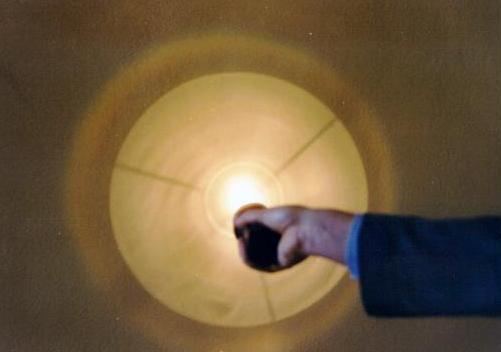

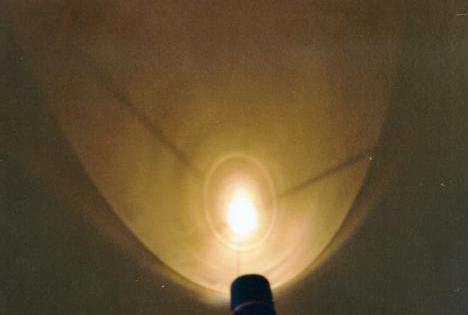
If we light up a wall with an electric torch keeping it perpendicular to the wall, the lit portion is more or less circular. Let's now begin tilting the torch upwards: the circle deforms and assumes an oblong shape, like a serving tray or a stadium: it's an ellipse.
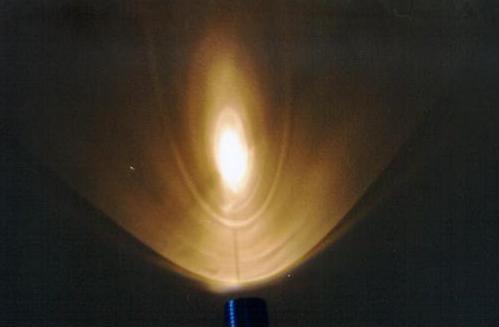
If we keep tilting the torch, the ellipse gets longer and longer. While one of its ends remains near us, the other moves further and further: if the wall were infinite, the lit area would become bigger and bigger, until for a certain inclination of the torch, it would become infinite. The figure thus obtained is a parabola.
If we tilt the torch even further, the lit area becomes even bigger, and it assumes the shape of a hyperbole.
The three figures which are obtained one after the other, or rather the curves that delimit them, are collectively called conical sections, since they are obtained sectioning a cone (in our case the cone of light projected by the torch) with a plane (the wall).
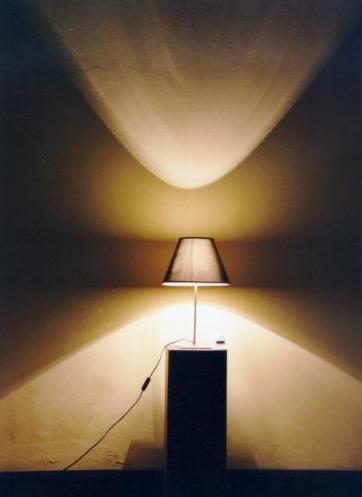
Conical sections are often found in the most common situations: a table lamp draws two hyperboles on the wall, the shadow of a ball is an ellipse, a stone thrown by a sling takes a parabolic path. In the past, the theory of conical sections was essential to build sundials. In its apparent motion, the sun draws a circumference: the rays that pass by the tip of a sundial's stylus then form a cone, that cut by the wall creates a conical section, which at our latitudes is a hyperbole, on which the shadow of the stylus's tip moves.
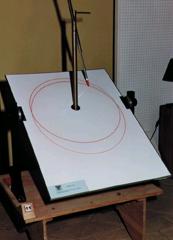
One can draw an ellipse using the great three-dimensional compasses which the Arab geometers had called the perfect compasses. The inclined rod that rotates around the vertical axis describes a cone, which is intersected by the drawing plane. According to the latter's inclination, one can obtain a circumference (if the plane is horizontal) or an ellipse, longer the more inclined the plane. If one could increase indefinitely the plane's inclination, one would obtain first a parabola and then a hyperbole.
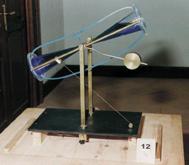
In the same way, depending on the machine's inclination, the plane of the water, which is always horizontal, intersects the water according to an ellipse, a parabola or a hyperbole. A second cone, symmetrical to the first, shows the two branches of the hyperbole.
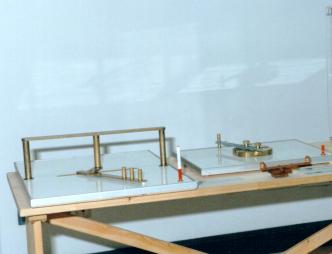
Other elliptical compasses, some of which are exhibited, can be built using the various properties of this curve: one can also find them on sale. A parabola or a hyperbole are more difficult to draw.