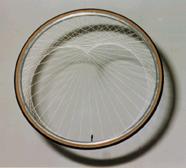
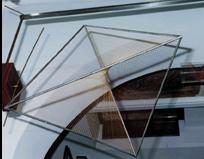
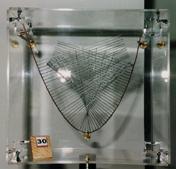
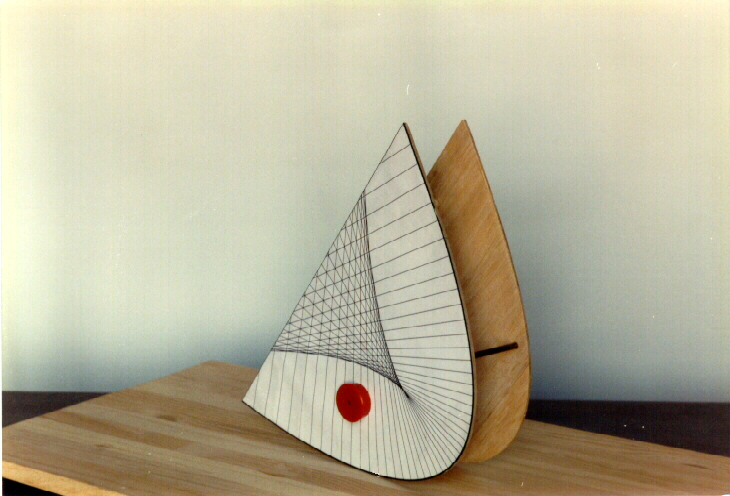
To build an envelope one need not start with straight lines - the same can be done with curves. Every curve of the family will be tangent to the envelope, that is it will have the same tangent line in the contact point. On the computer, it is possible to see various examples of envelopes of circles and also of more complex curves.
An interesting example comes from ballistics. Ignoring the resistance of air, the shell shot by an artillery piece will describe a parabola, the shape of which will depend on the power of the cannon and on the shooting angle. Let us suppose now that we have a cannon which always shoots with the same power, but that can vary the angle. Where must one stand to be sure one is outside the cannon's range?
The answer is simple: one traces all the shells' trajectories with varying angles, and one stands outside the region these cover. This region is delimited by the curve enveloping all the parabolas, which in this case is also a parabola.
Let us note that the caustics, and envelopes in general, are not curves that physically exist. What exist are the rays of light, or more in general the lines of the family. The curve that they envelop appears only because they concentrate on it. Thus the light rays concentrating on the caustic shed more light on the area of the plane corresponding to the curve, and they draw it. The same happens with the lines normal to the parabola, which can be seen in the entrance hall. They trace a curve that can be seen, although it does not exist - only the lines enveloping it exist.
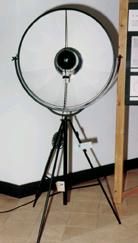 In some cases it is important to avoid
the formation of caustics, and to have a light which is
as uniform as possible. For example, in photography the
uniformity of illumination is essential. The Fortuny
lamp, which is still in use, thanks to the shape of its
reflecting surface, supplies a light density which is
constant in every point.
In some cases it is important to avoid
the formation of caustics, and to have a light which is
as uniform as possible. For example, in photography the
uniformity of illumination is essential. The Fortuny
lamp, which is still in use, thanks to the shape of its
reflecting surface, supplies a light density which is
constant in every point.